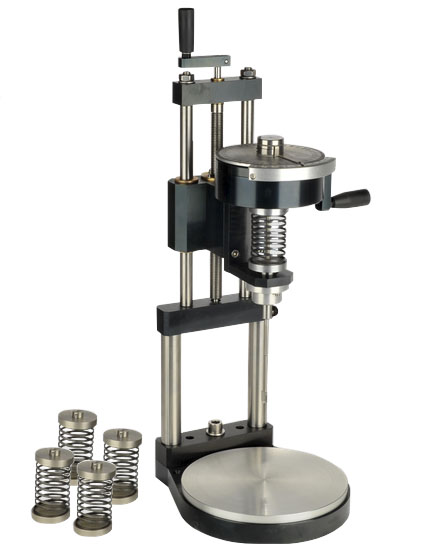
Consists of a torque head adjustable in height by means of a lead screw rotated by a drive wheel to enable the vane to be lowered into the specimen. Rotation of the vane is by means of an electrically operated rate of rotation is 1/60 R.P.M.
It operates a worm gear arrangement turning the upper end of a calibration torsion spring, vane dia, rod dia, vane size vane height are as per IS specifications.
The vane shaft is attached through the hollow upper shaft to are settable pointer, which indicates the angle indicates the angle of torque on a dial graduated in degree the dial reading multiplied by spring factor gives the torque a container for soil sample is also supplied a sampling tube of 38 and 100mm. i.d. 150mm long can also be used as container.
Supplied with set of four springs, one each of approx 2kgs/cm² , 4kgs/cm² , 6 kgs/cm², 8kgs/cm² and complete a wooden carrying case.
The BS model includes a drive belt, pulley set, and fixing studs. The test speed is 6 to 12 °/min.
The ASTM model includes a drive belt, pulley set, and fixing studs. The test speed is 60 to 90 °/min.
Procedure:
• Clean the apparatus thoroughly. Apply grease to the lead screw.
• Fill-up the sampling mould with remoulded soil at required density and moisture content or the undisturbed soil sample. Level the surface of the sample with the mould.
• Mount the sampling tube with sample under the base of the unit and clamp it in position.
• Bring the maximum pointer into contact with the strain indicating pointer. Note down the initial reading of these pointers on the circular graduated scale.
• Lower the bracket until the shear vanes go into the soil sample to their full length.
• Operate the torque applicator handle until the specimen fails, which is indicated by the return of the strain-indicating pointer or rotation of drum.
• Note down the readings of the maximum pointer.
• The difference between the two readings (initial & final) gives the angle of torque.
• Repeat steps 3 to 8, on a number of test specimens to obtain the average shear strength of the sample.
Observations and Calculations
Calculate Torque
Calculate torque using following formula.
T = Ø * K/180
Where,
T = Torque
Ø = Difference of angle (angle of torque)
K = Spring factor
Calculate Shear Strength
Shear strength of the soil, C is computed using the following formula
T = Cπ*[(d2h/2) + (d3/6)]
Where,
D = Diameter of vane (cm)
H = Height of the vane (cm)
C = Shear strength (kg/cm2)
T = Torque applied (kg-cm)